

Dear Parents & Students
2023 S4 IP/IB/IGCSE Grade Accelerator Programme
Here’s How We Intend To Help You Succeed.
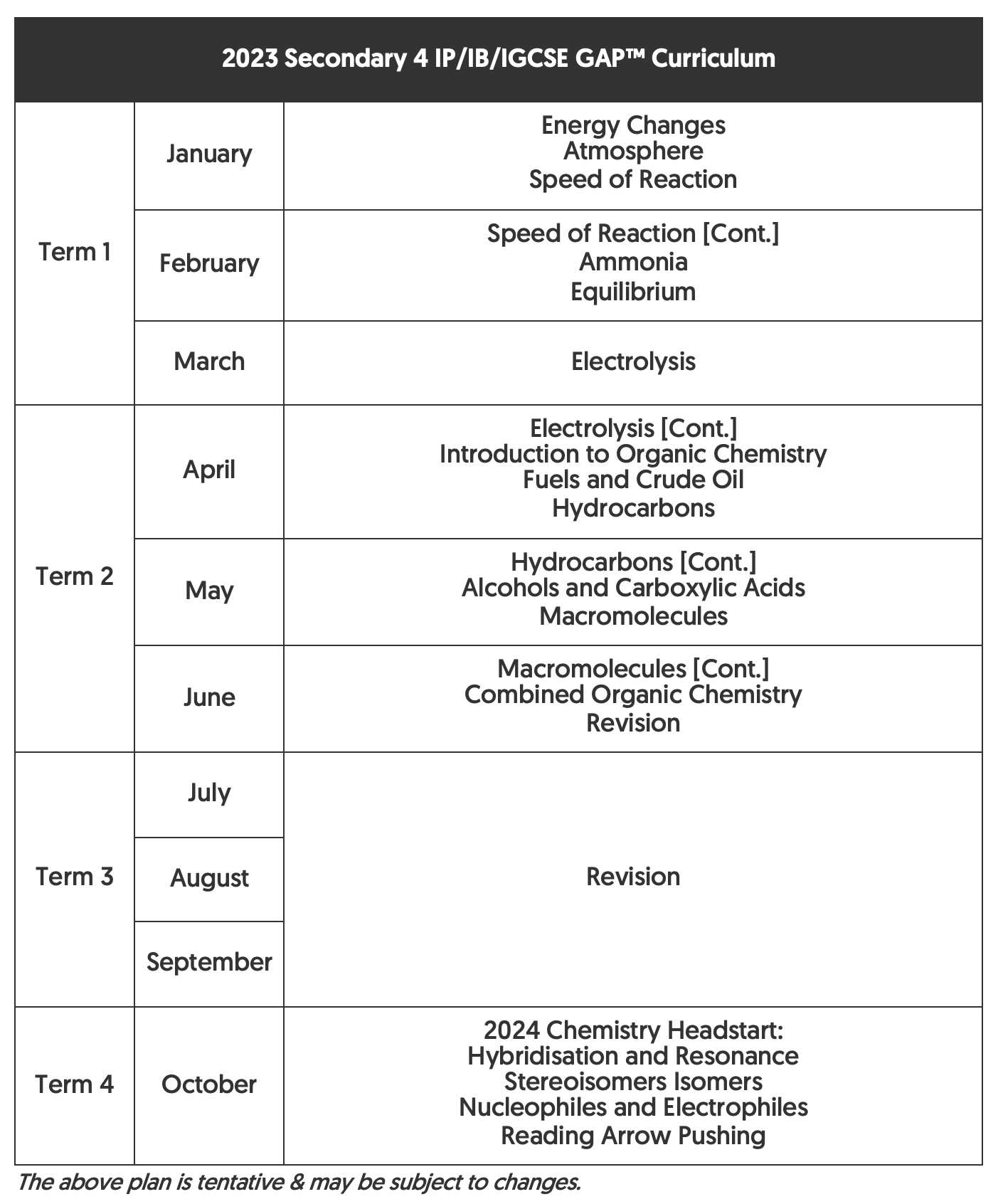
Here’s What We’ll Be Covering In The Upcoming Months
Challenge 1: Consolidating Content Knowledge & Identifying Areas of Focus.
As you may be aware, the content of the Chemistry syllabus is extensive – at this stage, students are required to possess the knowledge retention of the key Year 3 Chemistry foundational topics:
- Kinetic Particle Theory
- Chemical Bonding
- Stoichiometry & the Mole Concept
- Acids, Bases and Salts
Of course, each student will have their own strengths and weaknesses – the above topics may not be comprehensive enough to identify the areas of focus in their exam preparation as students may be weaker in other aspects.
If that’s the case, how should students begin to identify their areas of weakness? The answer is a simple but often overlooked solution – question exposure. With consistent question exposure, students will be able to identify the unknowns and knowledge gaps in their learning.
Here at The Pique Lab, the knowledge retention of the various topics is what we term a Level 1 Skillset – what then is a Level 2 Skillset?
Challenge 2: Concept Integration & Interpreting Data Analysis-Type Questions.
Complete Concept Integration, also known as CCI™, is a methodology that has been heavily emphasised at The Pique Lab since primary school.
Given that students are taught Science concepts at a topical level, they tend to treat each topic they learn as a standalone topic. However, foundational concepts such as Chemical Bonding & the Mole Concept mentioned in Challange 1 can be applied to almost any other topic in the syllabus.
By approaching topics individually, students are limited in their ability to dissect the questions in the way exam setters conceptualise them. Data Analysis questions will then get overwhelming for students preparing for the Year 4 Promotional Exam due to the sheer amount of concept integration across various topics required.
If students are not familiar with analysing & integrating these concepts with other topics, the consequence is obvious – a loss of marks during the examination.
The ability to quickly integrate various Science concepts across topics effectively is what we term a Level 2 Skillset.
Challenge 3: Time Management of the Examination Paper
Sitting for the Year 4 Promotional Exam is akin to the “Final Round” of Chemistry and students need to be well prepared to manage the rigours of completing the paper.
Students who have not trained themselves in the art of time management will find themselves struggling to complete the paper. This obstacle will be more pronounced when they encounter questions that cause them to deliberate excessively.
In the last lap of our Chemistry revision, we will place greater emphasis on speed, accuracy and the ability to manage exam stress when dealing with challenging questions across Papers 1 & 2.
Here’s How We Plan To Help You Succeed at The Pique Lab
We will be diving in-depth into the Year 4 Chemistry topics from January to June to finish the O-Level Chemistry syllabus.
For each topic, carefully curated past-year examination questions are compiled into In-Class Exercises (ICE), Homework (HW) and Topical Tests (TT).
The concepts from the ICE and HW worksheets are introduced in a systematic manner, enabling students to gain an understanding of the content with ease. At the end of each topic, an open-book topical test is administered. To complete your child’s topical revision, he/she will be provided with a topical study guide with blanks to be filled in. The study guides provide direction on the important memory work components for each topic and aid their understanding of the subject matter.
You may be wondering – Why are our topical tests open-book?
From our teaching experience, given the tight schedule of secondary school students, it is not realistic to expect students to prepare for the topical test the same way they do so for their school examinations. However, what is important is for us to assess whether your child knows where to find the relevant information from the materials provided. We also want to understand if your child is able to utilise the appropriate thought process to analyse and answer the examination questions accurately.
Over the years, we have also realised that the act of “flipping through the notes” to find answers during topical tests is a good way to force less disciplined students to get some revision done.
From July Onwards
We will begin the crucial run-up to the Promotional Examination from July onwards and commence our intensive revision by conducting topical recap & revision for our students. Students who may have forgotten the concepts taught in Year 3 topics will find this phase especially useful. Through this process, we aim to tackle the issues brought up earlier in Challenges 1 & 2
Thereafter, we will transit to utilising past-year examination papers to help students hone their examination skills and overcome Challenge 3.
From October Onwards
In October & November, we will begin the bridging for Year 5 to Year 6 Chemistry to give students a headstart for the upcoming year. These lessons will run till the end of November.
Given that Organic Chemistry will be approximately 30% of the upcoming syllabus, we will be covering selected foundational Organic Chemistry topics that will help students with their understanding more effectively.
Year 4 to Year 5 Chemistry Bridging Topics*
- Hybridisation and Resonance
- Geometric Isomers
- Nucleophiles and Electrophiles
- Electron Pushing for Mechanisms
*Subject to changes.
What If The Topic Sequence Doesn’t Match Your Child’s School Curriculum?
As you may be aware, different schools teach topics in different sequences and your child’s school curriculum may not be perfectly aligned with the curriculum of our Grade Accelerator Programme.
Here at The Pique Lab, we teach an accelerated curriculum and our end goal is to cover the entire syllabus and have ample time for revision for the final year examination.
If your child has not learned a topic that is taught during the Grade Accelerator Programme, it will be a head start for him/her before the topic is taught during the school curriculum.
If your child has learnt it in school previously, it will be a good reinforcement for him/her as he/she might not have a thorough understanding of the topic when he/she was taught in school.
Throughout your child’s academic year with us, should he/she be taught a different topic from our internal curriculum, we will provide an additional topical study guide, on request, for him/her to work on in his/her own time.
Is Your Child Ready For The Big Year Ahead?
Over the years, we have also learnt that parents play a pivotal role in the academic success of their child. In particular, we discovered that students typically achieve breakthroughs faster in Science if their parents coach and monitor them at home regularly.
In order to offer the best learning experience for your child, we also strive to provide an amazing support system for parents, like you.
For starters, here is how you can help your child improve more quickly:
#1: Ensure that your child completes his/her homework properly & punctually and brings them back to class.
#2: Ensure that your child reviews our notes and worksheets during the week.
#3: Ensure that your child is adequately prepared for our tests.
#4: If your child is unclear of a concept or has a question, he/she is highly encouraged to approach his/her teacher.
Please note that only topical tests & graded assignments given in the weekly classes will be marked for all learning arrangements. Homework that is given in the weekly classes will be reviewed together as a class and will not be marked.
Thank you & all the best! 😇